

Assassin's Creed 4 Black Flag Review
Call me Edward.
Nosotros've at present had the opportunity to play the Xbox I version of Assassin's Creed IV, and there are no manner ways effectually it: this version just doesn't wait as nice every bit information technology does on PlayStation four. The differences, however are slight. The PlayStation four version boasts a higher resolution, making detailed edges--similar the leaves of a palm tree, or the rope nets on a ship--smoother and less jagged. But taken on its ain, the Xbox I version still looks fantastic, with the impressive lighting and water effects that make sailing the Caribbean in this game such a joy. While the PS4 version does look better, you won't exist disappointed by Assassinator'due south Creed IV on Xbox 1. - SM, 11/21/2013, 09:00 PST
How far tin you stray from home before it's impossible to ever return? That's the question at the heart of Assassin'due south Creed Iv: Black Flag. Information technology's something that plagues Edward Kenway, the game'southward roguish hero, as he explores the Caribbean in search of wealth and the dream of returning to England a more respectable man. But for as much every bit Kenway longs for the day he can leave the pirate life backside, the freedom of the open ocean is a difficult matter to resist. And who can blame him? Because after this stunning and beautifully realized tale of adventure on the high seas, information technology's hard to imagine the Assassin's Creed series returning to its landlocked roots
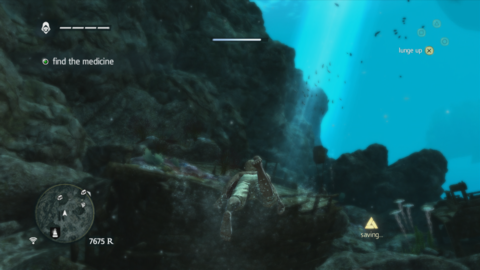
The world of Blackness Flag is nothing short of remarkable. This is the most expansive setting in the history of the franchise, a virtual rendition of the W Indies that encompasses all manner of burgeoning colonies, Mayan ruins, and deadly jungles. Cities like Havana and Nassau reflect the serial' trademark attention to item, from the stonework cathedrals of the former to the ramshackle taverns of the latter. And then at that place are the remote islands inhabited by nothing more than venereal and ocean turtles, underwater shipwrecks waiting to be explored, and vast stretches of sparkling Caribbean waters that are every fleck as deadly as they are gorgeous.
Indeed, what makes Blackness Flag and then special is the manner it captures the thrill of sailing the open sea. It's more than the spectacle of a humpback whale leaping into the air and spraying the deck of your ship, or the sound of your crew breaking out into a sea shanty just as the sun is outset to set beyond the horizon. Information technology's the feeling that there's e'er something out there to exist discovered, rewards waiting to be captured no matter who'southward standing in your way.
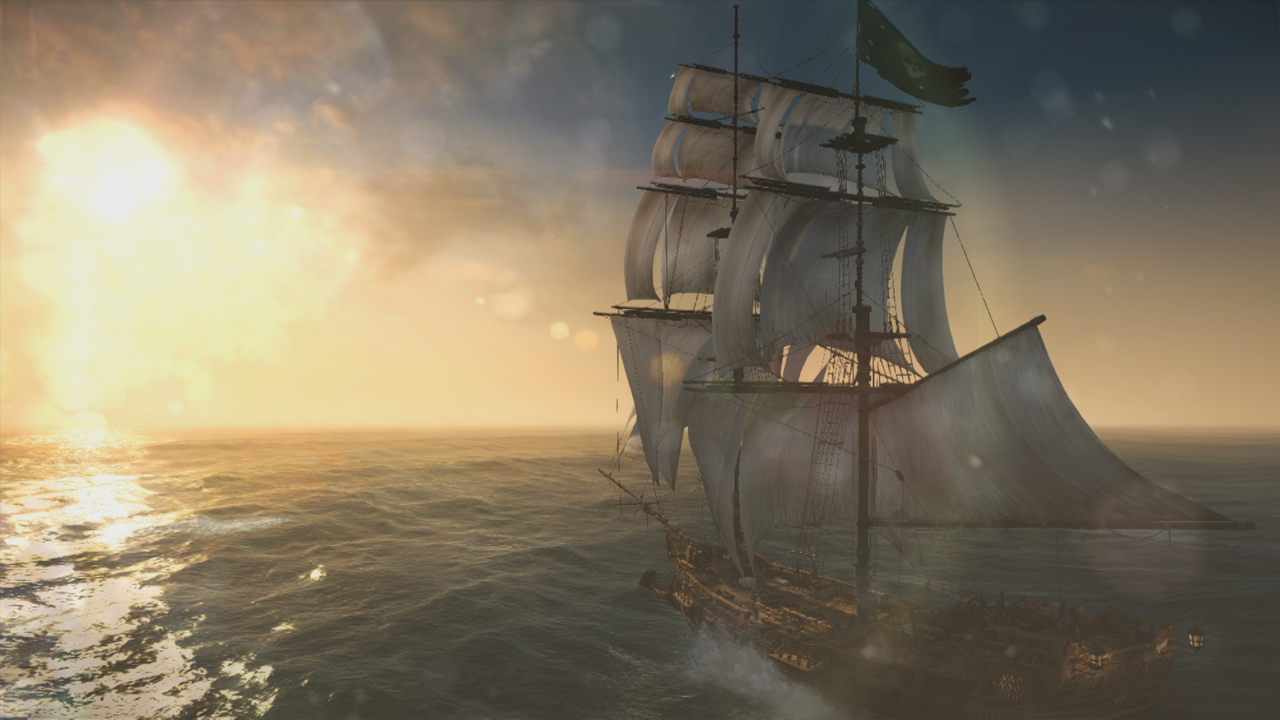
What began every bit a series of isolated side missions in Assassin'southward Creed III has exploded into a total-fledged means of exploration, discovery, and combat. Early on into Black Flag, Kenway takes the helm of the Jackdaw, a pirate ship that has clearly seen ameliorate days. From there, information technology'south your charge to build the Jackdaw into a vessel capable of taking on the most powerful warships in the Caribbean area. After all, that Spanish gilded isn't going to plunder itself.
Taking on naval superpowers seems like a tall lodge early, but pushing yourself to better your one time-rickety ship is a process that Blackness Flag makes incredibly rewarding. This is a game that gives you an cool number of ways to acquire the coin and resources needed to agree your own at sea. You might run off in search of buried treasure using nothing more than a crudely drawn map, or silently infiltrate a military storehouse to collect the wood and metal needed to bolster the Jackdaw'south hull. That bit of flotsam floating in the distance might be a crate of rum you can sell to make up the difference on your new mortar upgrades, or it might be a stranded crewman you can rescue to expand the size of your crew. Black Flag doesn't just present a beautiful world; it gives you a mountain of reasons to run off and go exploring.
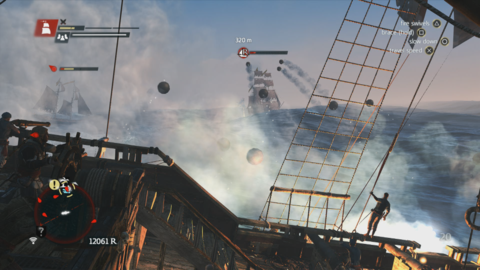
Upgrading your send is critical because Black Flag places a huge emphasis on naval combat. Both the storyline and side missions are total of tense body of water battles, where strategic positioning and explosive cannon fire come together in exhilarating contests of naval supremacy. It'due south a system that allows for a multifariousness of tactics while never getting bogged down in overly circuitous controls, whether you're picking off enemies from afar with a well-placed mortar strike or dumping explosive barrels into the path of an unsuspecting foe. Whatever approach you accept, managing sea battles is an accented blast.
It's not only wanton mayhem, either. Black Flag encourages y'all to take pause and survey the landscape before charging into a fight. With the aid of your spyglass, you can scout another ship's cargo to decide whether the resources onboard match your electric current needs, besides equally scout out how much coin yous'll exist able to loot. This same tool also reveals an enemy'southward overall gainsay level, letting you know if yous should warm up against a few more than level-8 schooners before taking on that level-20 frigate. All this reconnaissance makes naval combat that much more satisfying; success comes not but from how accurately you lob your cannons, but from how adeptly you lot measure out the take chances versus the advantage.
These naval battles often lead directly into more traditional Assassinator's Creed swordfighting, and it'south in those seamless transitions that Black Flag fuses its 2 halves into 1 cohesive whole. Destroying a send outright rewards y'all with only one-half its cargo, so you need to board these vessels and wear down their reluctant crews to reap the full reward. That ways swinging acrobatically from i ship to another, exchanging sword strikes with enemy sailors, and watching your coiffure erupt in cheers once those enemies accept surrendered. A similar transition occurs during the game'southward numerous fort takeover missions, where you bombard the defenses of a seaside fortress by send before charging into the ensuing anarchy to electrocute its officers amidst a tempest of fire and smoke.
Black Flag doesn't just present a beautiful globe; it gives yous a mount of reasons to run off and go exploring.
That these acts of naval piracy continue to exist so heady so deep into the game'due south lengthy story campaign is a attestation to just how excellent Black Flag's progression loop is. Raid an enemy gunboat, and you can bit it for parts or send information technology on trade road missions to earn more money on the side. Overtake a fort, and you lot'll unlock dozens of new activities on the map, whether they're the location of great white sharks whose skin yous can turn into improved armor or an underwater shipwreck y'all can explore once you've saved upwards enough for that diving bell. No matter where you go or what you practise, it'due south most impossible to experience like you're not advancing in some fashion.
And information technology'south a quick game to accelerate, too. Assassin's Creed III'south crawling preamble and frequent pacing bug are nowhere to be found hither, as Black Flag wastes no time throwing you into the life of a pirate. The story revolves around the aforementioned Edward Kenway, a charming troublemaker from Bristol by way of Swansea. If his name sounds familiar, it should: Edward is the grandfather of ACIII protagonist Connor Kenway. The elder Kenway'southward backstory is rooted in a fairly standard trope--a peasant off in search of wealth to build a better life dorsum home--but it's his unique identify in the series' overarching fiction, and the universal themes the story explores, that makes the narrative shine.
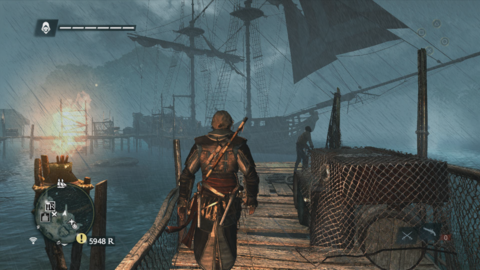
At the game's outset, Kenway is neither assassin nor templar. He's a human being whose only allegiance lies with his ship'south crew, playing both factions against one another for his own gain. But equally the years habiliment on, the luster of youthful indiscretion fades away as Kenway wrestles with a want to find some greater purpose and a longing to practise right past his estranged wife back home. It'southward a story that explores the human side of pirates, painting larger-than-life figures in a low-cal that even manages to plough Blackbeard into a sympathetic graphic symbol.
The narrative grows a bit unwieldy toward the stop, but finds its footing but earlier a credit sequence that is far more touching than any story virtually pirates has a correct to be. An eclectic cast of side characters briefly dance with just never fully tackle more powerful themes like race and gender in the age of colonialism, merely such narrative flirtations are 1 of the few shortcomings in an otherwise terrific story. Even the modern-twenty-four hour period capacity--brief and innocuous as they may be--manage to add a refreshing and occasionally humorous take to the Abstergo story arc.
Despite the presence of pirates and scoundrels, the earth of Black Flag is a consistently gorgeous 1. The Assassin's Creed series has always had a knack for establishing an engrossing sense of place in its dense urban landscapes, and Ubisoft hasn't missed a stride in applying that same level of craftsmanship toward the islands and jungles of the Caribbean. Blackness Flag looks especially impressive on the PlayStation iv, where improved lighting and a greater resolution bathe the world in a terrific level of visual fidelity and artistic flourishes. Y'all're better able to detect the lilliputian things, like the style foliage gives way to Kenway while he sneaks through the bushes, or the realistic flutter of fabric on your sails when a potent wind sweeps beyond the sea. The current-generation versions of Black Flag yet look terrific, but all those little details in the PlayStation 4 version draw you into the globe that much more.
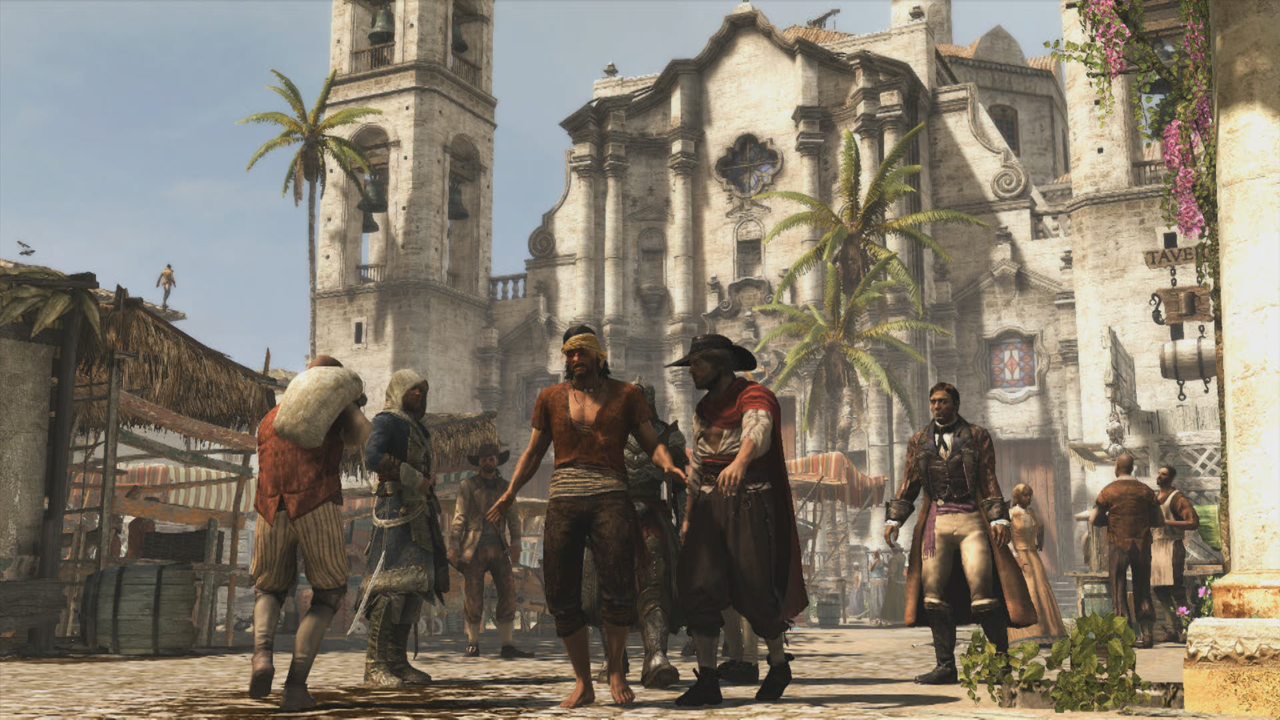
Kenway'southward adventures on dry out state don't amount to the same wholesale reinvention of the series that his time aboard the Jackdaw does, but these portions of the game have hardly been ignored. Ubisoft has borrowed a number of concepts from Far Cry three, and they improve the on-human foot experience immensely. Crafting beast hides into better equipment is a far greater incentive to chase wild animals than it was in ACIII, while the ability to demolition warning bells in an enemy base of operations adds more than flexibility to the stealth experience. But once a fight breaks out into a full-on melee, Blackness Flag begins to feel much more than similar its predecessors: swordfighting is equally fluid and lively every bit e'er, only lacks any substantial refinements over previous games.
Where that sense of deja vu hits Black Flag the hardest is in its overuse of eavesdropping missions. Throughout the chief story, the game asks yous time and again to tail your targets (but non too closely!) and eavesdrop on their conversations (but non also obviously!) before finally letting you decide what to do with them. These types of missions--a staple of the very kickoff game in the series--had already begun to show their age in contempo Assassin's Creed installments, and time hasn't done them whatever favors since then.
While less glaring, a similar lack of advancement tin be found in Black Flag'southward multiplayer. The cat-and-mouse nature of Wanted and the co-op chaos of Wolfpack are still tremendous fun, but outside of a new story-driven tutorial mode, at that place aren't any substantial additions. Even though Assassin's Creed multiplayer has always occupied something of an "icing on the block" part, it'due south a shame this role of the game hasn't enjoyed the same creative renewal that its single-thespian portion has.
But these moments of stagnation are isolated events in what is, ultimately, a massive and highly aggressive game. Black Flag presents a world total of hazard and opportunity, where treasures scavenged in a remote jungle can be used to turn the tide in a massive naval boxing against mighty Spanish warships. It'south a game where you can sail the seas for hours at a time, either hunting groovy white sharks or simply listening to your crew sing one infectious sea shanty after the next. At that place's an incredible telescopic to what you can practice in Blackness Flag, with a level of harmony between its component parts that encourages y'all to endeavor it all, and a story that keeps you invested throughout the whole thing. If there was ever any question that Assassinator's Creed needed something ambitious to go the series back on runway, Black Flag is that game and then some.
Back To Meridian
Source: https://www.gamespot.com/reviews/assassin-s-creed-iv-black-flag-review/1900-6415509/
Posted by: burbankcolooter.blogspot.com
0 Response to "Assassin's Creed 4 Black Flag Review"
Post a Comment